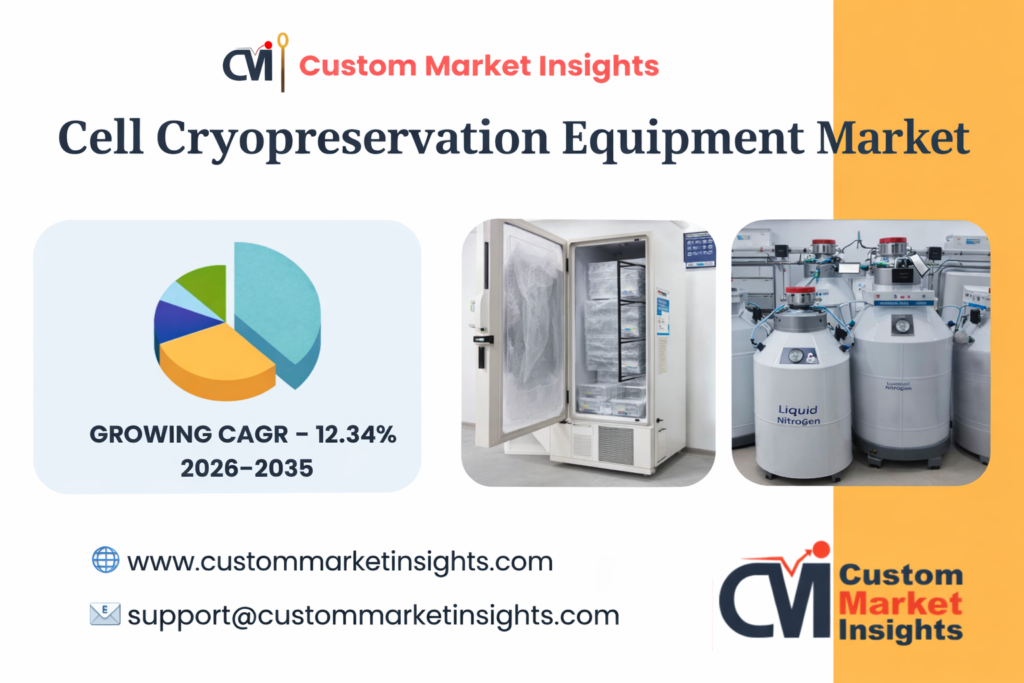
The global Cell Cryopreservation Equipment Market is witnessing robust growth, driven by advancements in biotechnology, regenerative medicine, and increasing demand for long-term biological sample storage. As per the analysis conducted by CMI, the market is projected to grow at a CAGR of 12.34% from 2026 to 2035. The market size was valued at USD 3.09 Billion in 2026 and is anticipated to reach approximately USD 8.73 Billion by 2035, reflecting strong momentum across research, clinical, and industrial applications.
Market Overview
Cell cryopreservation refers to the process of preserving cells at extremely low temperatures, typically using liquid nitrogen or specialized freezers, to maintain their viability for extended periods. This technology is critical in fields such as stem cell research, fertility preservation, drug development, and biobanking. The growing adoption of personalized medicine, increasing stem cell therapies, and expansion of IVF procedures are major contributors to market growth.
Cryopreservation equipment includes a wide range of tools such as ultra-low temperature freezers, liquid nitrogen tanks, incubators, and storage containers, along with consumables like cryogenic vials and tubes. These systems ensure controlled cooling, safe storage, and efficient retrieval of biological samples.
Market Drivers
1. Rising Demand for Stem Cell Research
The growing focus on regenerative medicine and stem cell therapy is one of the primary drivers of the cell cryopreservation equipment market. Stem cells require precise storage conditions to maintain viability, which significantly boosts demand for advanced cryopreservation systems.
2. Expansion of Biobanking
Biobanks play a crucial role in storing biological samples for research and clinical use. The increasing number of biobanks globally, especially in developed regions, is driving the demand for reliable and scalable cryopreservation equipment.
3. Growth in IVF and Fertility Treatments
The rise in infertility rates and increasing adoption of assisted reproductive technologies (ART), including IVF, is contributing significantly to the demand for cryopreservation equipment. Reproductive cells such as sperm, eggs, and embryos require safe and long-term storage solutions.
4. Increasing Biopharmaceutical R&D Activities
Pharmaceutical and biopharmaceutical companies are investing heavily in research and development, particularly in biologics and cell-based therapies. This drives the need for advanced cryopreservation systems to store cell lines and biological materials.
Market Restraints
Despite strong growth potential, the market faces certain challenges:
- High Cost of Equipment: Advanced cryopreservation systems and liquid nitrogen storage tanks can be expensive, limiting adoption among smaller laboratories.
- Technical Complexity: Proper handling and maintenance of cryogenic systems require skilled professionals.
- Risk of Sample Contamination: Improper storage or handling can lead to contamination or loss of valuable samples.
Market Opportunities
- Emerging Markets: Countries like India, China, and Brazil offer significant growth opportunities due to expanding healthcare infrastructure and research capabilities.
- Technological Advancements: Innovations such as automated cryopreservation systems and smart monitoring solutions are expected to drive market growth.
- Personalized Medicine: Increasing focus on individualized treatment approaches will boost demand for cell storage technologies.
Market Segmentation
By Product
The product segment includes:
- Equipment
- Freezers
- Liquid Nitrogen Supply Tanks
- Incubators
- Consumables/Accessories
- Cryogenic Vials
- Cryogenic Tubes
- Cooler Boxes/Containers
Among these, freezers and liquid nitrogen tanks dominate the market due to their critical role in maintaining ultra-low temperatures required for cell preservation. Consumables such as vials and tubes also hold a significant share due to their recurring usage.
By Application
The market is segmented into:
- Stem Cells
- Reproductive Cells
- Bioproduction Cell Lines
- Primary Cells
Stem cell applications account for the largest market share due to increasing research and clinical applications. Meanwhile, reproductive cells are witnessing rapid growth driven by rising IVF procedures globally.
By End-Use
Key end-use segments include:
- Biopharmaceutical & Pharmaceutical Companies
- Academic and Research Institutes
- Biobanks
- IVF Clinics
Biopharmaceutical companies dominate this segment due to extensive R&D activities. However, biobanks and IVF clinics are expected to witness significant growth during the forecast period.
Regional Analysis
North America
North America holds the largest market share due to advanced healthcare infrastructure, strong presence of key players, and high investment in research activities. The United States leads the region with extensive biobanking and stem cell research initiatives.
Europe
Europe is another significant market, driven by increasing government funding for research and growing adoption of advanced medical technologies. Countries like Germany, the UK, and France are major contributors.
Asia Pacific
The Asia Pacific region is expected to witness the fastest growth during the forecast period. Countries such as China, India, and Japan are investing heavily in biotechnology and healthcare infrastructure, creating strong demand for cryopreservation equipment.
Middle East & Africa
This region is experiencing gradual growth, supported by improving healthcare facilities and rising awareness about advanced medical treatments.
Latin America
Latin America is emerging as a promising market, with Brazil and Argentina leading in healthcare advancements and research activities.
Competitive Landscape
The cell cryopreservation equipment market is highly niche and competitive, with several global and regional players focusing on innovation, product development, and strategic collaborations.
Some of the key players include:
- Thermo Fisher Scientific Inc.
- Azenta US Inc.
- MVE Biological Solutions
- INOXCVA
- Haier Biomedical
- Kirsch GmbH
- Planer (a Hamilton Thorne company)
- Eppendorf SE
- Labtron Equipment Ltd.
These companies are focusing on expanding their product portfolios, enhancing technological capabilities, and strengthening their global presence through partnerships and acquisitions.
Key Trends Shaping the Market
Automation and Smart Monitoring
Modern cryopreservation systems are increasingly integrated with automation and IoT-based monitoring, allowing real-time tracking of temperature and storage conditions.
Sustainability Initiatives
Manufacturers are developing energy-efficient systems to reduce operational costs and environmental impact.
Integration with AI and Data Analytics
Advanced data analytics tools are being integrated into cryopreservation systems to improve storage efficiency and minimize risks.
Future Outlook
The future of the cell cryopreservation equipment market looks highly promising, with strong growth expected across all regions. The increasing demand for biologics, advancements in regenerative medicine, and expansion of research activities will continue to drive market growth.
Emerging technologies, combined with rising healthcare investments in developing economies, are expected to create new opportunities for market players. Furthermore, the growing emphasis on personalized medicine and precision healthcare will further boost the demand for efficient and reliable cryopreservation solutions.
