Market Size
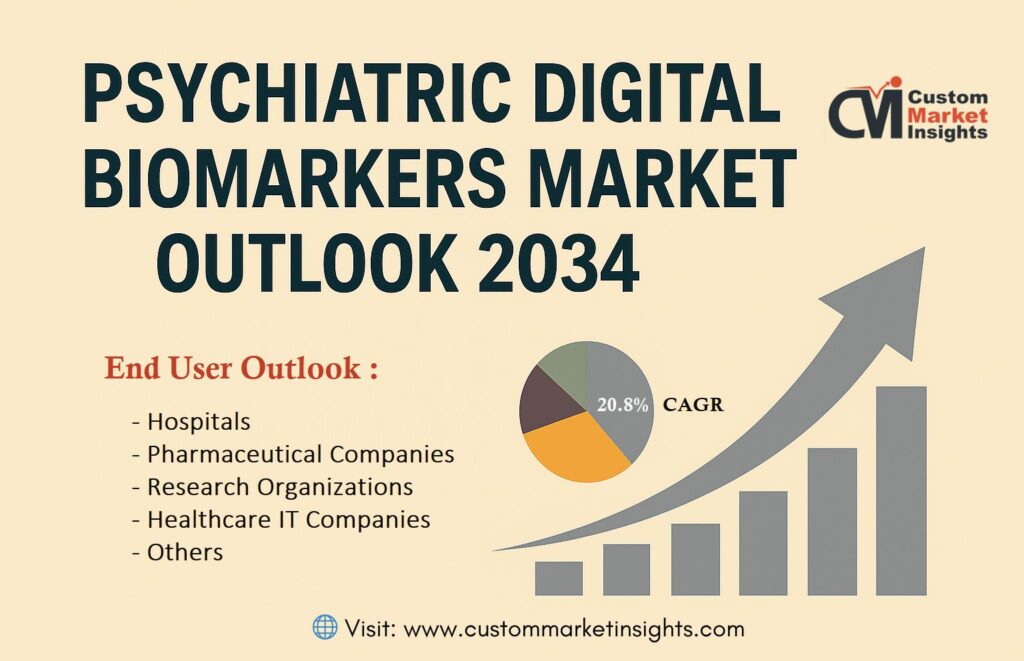
As per the in-depth market analysis, the Global Psychiatric Digital Biomarkers Market is poised for substantial growth over the forecast period. The market is expected to register a strong CAGR of 20.8% from 2025 to 2034, reflecting rapid technological advancements and increasing demand for objective mental health assessment tools.
In 2025, the market is estimated at USD 680 Million, and it is projected to reach approximately USD 3,800 Million by 2034. This remarkable growth trajectory highlights the increasing integration of digital technologies such as artificial intelligence (AI), wearable devices, and mobile health applications in psychiatric care.
Market Overview
Psychiatric digital biomarkers refer to objective, quantifiable physiological and behavioral data collected through digital devices that help in diagnosing, monitoring, and predicting mental health conditions. These biomarkers are derived from sources such as smartphones, wearable sensors, and neuroimaging tools.
Unlike traditional psychiatric assessments that rely heavily on subjective reporting, digital biomarkers offer real-time, continuous, and data-driven insights into mental health conditions such as depression, anxiety, schizophrenia, and bipolar disorder.
The market is gaining traction due to the global rise in mental health disorders, growing awareness about mental health, and the need for early diagnosis and personalized treatment approaches. Additionally, the COVID-19 pandemic accelerated the adoption of digital health tools, further boosting the market.
Key Market Growth Drivers
1. Rising Prevalence of Mental Health Disorders
The increasing global burden of psychiatric conditions is a major growth driver. Disorders such as depression, anxiety, and schizophrenia are becoming more prevalent, creating a strong demand for accurate and scalable diagnostic solutions.
2. Advancements in Wearable and Mobile Technologies
The proliferation of wearable devices and smartphones enables continuous monitoring of behavioral and physiological parameters such as sleep patterns, activity levels, and speech patterns. These technologies form the backbone of digital biomarkers.
3. Growing Adoption of AI and Machine Learning
AI-powered analytics allow for the interpretation of large datasets collected through digital devices. Machine learning algorithms can detect subtle behavioral changes, enabling early diagnosis and intervention.
4. Shift Toward Personalized Medicine
Healthcare systems are increasingly moving toward personalized treatment approaches. Digital biomarkers provide individualized insights, allowing clinicians to tailor therapies based on patient-specific data.
5. Increased Investments in Digital Health
Governments, venture capital firms, and healthcare organizations are heavily investing in digital health innovations, including psychiatric biomarkers, fueling market expansion.
Analysis of Key Players – Key Player Strategies
The competitive landscape of the psychiatric digital biomarkers market is characterized by a mix of technology companies, healthcare IT firms, and pharmaceutical companies.
Key Strategies Adopted by Market Players:
- Strategic Partnerships & Collaborations
Companies are partnering with healthcare providers, research institutions, and pharma companies to enhance product development and expand market reach. - Product Innovation and R&D Investments
Continuous investment in research and development is enabling the launch of advanced digital biomarker platforms with improved accuracy and usability. - Integration with Clinical Workflows
Market players are focusing on integrating digital biomarker tools into existing healthcare systems to ensure seamless adoption by clinicians. - Regulatory Approvals and Compliance
Obtaining regulatory approvals is a key strategy to build trust and ensure widespread adoption. - Expansion into Emerging Markets
Companies are targeting high-growth regions such as Asia Pacific and Latin America to tap into unmet healthcare needs.
Market Challenges & Opportunities
Challenges
1. Data Privacy and Security Concerns
The collection of sensitive mental health data raises concerns about privacy and data protection, which may hinder adoption.
2. Lack of Standardization
There is currently no universal standard for digital biomarkers, making it difficult to validate and compare results across platforms.
3. Regulatory Hurdles
Strict regulatory frameworks for digital health technologies can delay product approvals and market entry.
4. Limited Clinical Validation
Despite technological advancements, some digital biomarkers still lack extensive clinical validation, affecting their credibility.
Opportunities
1. Integration with Telepsychiatry
The growing adoption of telehealth services presents a significant opportunity for digital biomarkers to enhance remote patient monitoring.
2. Expansion in Emerging Markets
Developing regions offer untapped potential due to increasing healthcare investments and rising awareness about mental health.
3. Pharmaceutical Applications
Digital biomarkers can be used in clinical trials to improve drug development processes and monitor patient responses.
4. AI-Driven Predictive Analytics
The use of AI to predict mental health conditions before symptom onset is a promising area for future growth.
Investment Landscape and ROI Outlook
The psychiatric digital biomarkers market is attracting significant investments from venture capitalists, private equity firms, and strategic investors. The high CAGR of 20.8% indicates strong potential for returns on investment.
Investment Trends:
- Increased funding for startups developing AI-based mental health solutions
- Strategic acquisitions by large healthcare and technology firms
- Government initiatives supporting digital health infrastructure
ROI Outlook:
Investors can expect high long-term returns due to:
- Rapid market expansion
- Increasing adoption of digital health tools
- Growing demand for mental health solutions
However, ROI may depend on factors such as regulatory approvals, technological advancements, and market penetration strategies.
Market Segmentations (with Region)
By Type
- Neurophysiological Biomarkers
- Behavioral Biomarkers
- Cognitive Biomarkers
- Sleep Pattern Biomarkers
- Others
Among these, behavioral and sleep pattern biomarkers are gaining significant traction due to their ease of data collection through wearable devices.
By Clinical Practice
- Diagnostic Applications
- Therapeutic Applications
- Prognostic Applications
Diagnostic applications currently dominate the market, while therapeutic applications are expected to grow rapidly with the adoption of personalized treatment approaches.
By End User
- Hospitals
- Pharmaceutical Companies
- Research Organizations
- Healthcare IT Companies
- Others
Hospitals and research organizations are leading adopters due to their focus on clinical validation and patient care.
Regional Coverage
North America
- U.S.
- Canada
- Mexico
North America holds the largest market share due to advanced healthcare infrastructure, high adoption of digital technologies, and strong presence of key players.
Europe
- Germany
- France
- U.K.
- Italy
- Spain
- Netherlands
- Russia
Europe is witnessing steady growth supported by government initiatives and increasing awareness of mental health.
Asia Pacific
- China
- Japan
- India
- South Korea
- Australia
- Taiwan
Asia Pacific is expected to register the fastest growth due to rising healthcare investments, increasing smartphone penetration, and growing mental health awareness.
Middle East & Africa
- Saudi Arabia
- UAE
- South Africa
- Egypt
- Kuwait
This region is gradually adopting digital health technologies, driven by improving healthcare infrastructure.
Latin America
- Brazil
- Argentina
Latin America shows promising growth potential with increasing focus on mental health and digital transformation.
Why Buy This Report?
- Comprehensive Market Insights: Detailed analysis of market size, trends, and forecasts from 2025 to 2034
- In-depth Segmentation: Clear understanding of market segments and their growth potential
- Competitive Analysis: Insights into key players and their strategies
- Investment Opportunities: Identification of high-growth areas and ROI potential
- Data-Driven Decisions: Reliable data and forecasts to support strategic planning
- Emerging Trends: Coverage of technological advancements and future market developments
FAQs
1. What are psychiatric digital biomarkers?
Psychiatric digital biomarkers are objective data points collected through digital devices that help in diagnosing and monitoring mental health conditions.
2. What is driving the growth of this market?
Key drivers include rising mental health disorders, advancements in wearable technology, AI integration, and increased investment in digital health.
3. Which region dominates the market?
North America currently leads the market due to strong healthcare infrastructure and early adoption of digital technologies.
4. What are the major challenges in the market?
Challenges include data privacy concerns, lack of standardization, regulatory hurdles, and limited clinical validation.
5. What is the future outlook of the market?
The market is expected to grow significantly, reaching USD 3,800 Million by 2034, driven by technological advancements and increasing demand for personalized mental healthcare solutions.
