Market Size
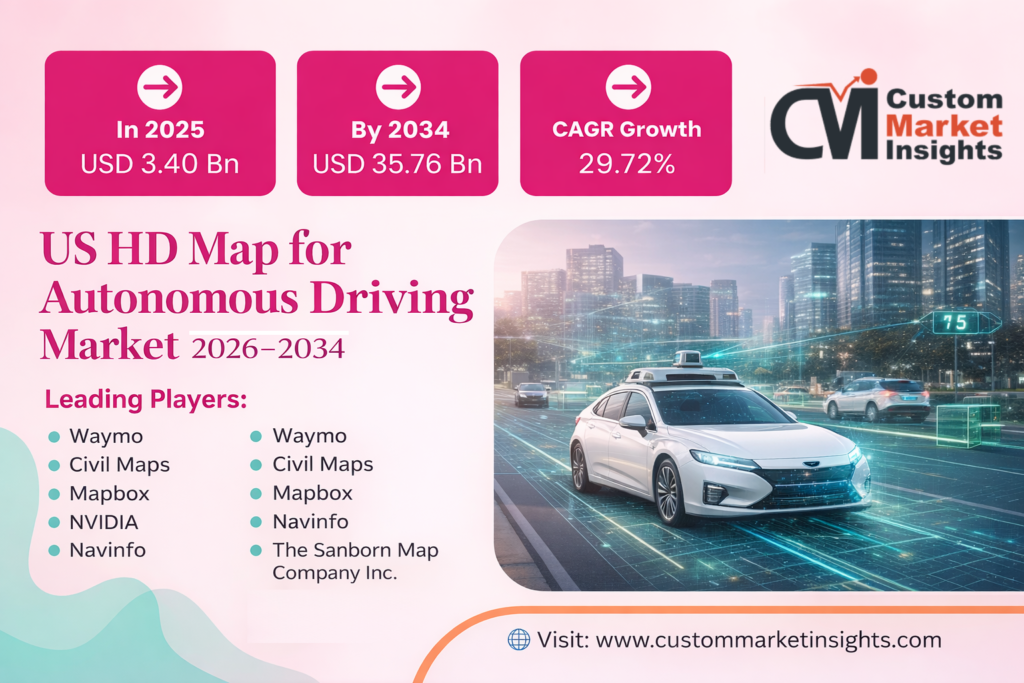
The U.S. HD Map for Autonomous Driving Market is poised for exponential growth over the forecast period. According to analysis conducted by the CMI team, the market is projected to register a remarkable CAGR of 29.72% from 2026 to 2034.
In 2026, the market size is estimated at USD 3.40 billion, reflecting the early-stage yet rapidly evolving nature of high-definition (HD) mapping technologies. By 2034, the market valuation is expected to reach approximately USD 35.76 billion, driven by the increasing commercialization of autonomous vehicles and advancements in mapping technologies.
This rapid expansion underscores the critical role HD maps play in enabling precise navigation, real-time decision-making, and enhanced safety in autonomous driving systems.
Market Overview
HD maps are a foundational component of autonomous driving systems, offering centimeter-level accuracy and real-time environmental data that traditional navigation maps cannot provide. These maps include detailed information such as lane boundaries, road geometry, traffic signals, pedestrian crossings, and dynamic elements like construction zones.
In the U.S., the growing adoption of autonomous vehicles—both passenger and commercial—is significantly boosting demand for HD mapping solutions. Technology companies, automotive OEMs, and mapping service providers are collaborating to create robust, scalable, and continuously updated mapping ecosystems.
Additionally, the integration of artificial intelligence (AI), machine learning, and cloud computing into HD mapping platforms is enhancing data processing capabilities and enabling real-time updates, making autonomous driving safer and more reliable.
Key Market Growth Drivers
1. Rising Adoption of Autonomous Vehicles
The increasing deployment of semi-autonomous and fully autonomous vehicles across the U.S. is a major growth driver. Automakers and tech companies are heavily investing in self-driving technologies, which rely on HD maps for navigation and situational awareness.
2. Advancements in Sensor Technologies
The proliferation of LiDAR, radar, and camera-based systems is generating vast amounts of data, which is used to build and update HD maps. These technologies improve map accuracy and enable real-time updates, enhancing vehicle safety and performance.
3. Expansion of Smart Infrastructure
Government initiatives aimed at developing smart cities and connected infrastructure are supporting the growth of HD mapping solutions. Infrastructure equipped with IoT sensors can provide real-time data to HD maps, improving navigation accuracy.
4. Growth in Commercial Autonomous Applications
The logistics and transportation sectors are increasingly adopting autonomous solutions for last-mile delivery, fleet management, and long-haul trucking. This is driving demand for HD maps tailored to commercial vehicle operations.
5. Increasing Investments in AI and Cloud Technologies
Cloud-based HD mapping solutions are gaining traction due to their scalability and ability to process large datasets. AI-powered analytics further enhance map accuracy and enable predictive capabilities.
Analysis of Key Players & Key Player Strategies
The U.S. HD map for the autonomous driving market is highly competitive, with several prominent players driving innovation and market expansion.
Leading Players
- Waymo
- Civil Maps
- Mapbox
- NVIDIA
- NavInfo
- The Sanborn Map Company Inc.
- Esri
Key Player Strategies
1. Strategic Partnerships & Collaborations
Companies are forming alliances with automotive manufacturers, technology providers, and government agencies to expand their mapping capabilities and market reach.
2. Continuous Innovation
Investments in AI, machine learning, and sensor fusion technologies are enabling companies to improve map accuracy and real-time capabilities.
3. Geographic Expansion
Key players are expanding their mapping coverage across urban and rural areas in the U.S. to support wider deployment of autonomous vehicles.
4. Cloud Integration
The adoption of cloud-based platforms allows for scalable data processing and seamless updates, ensuring maps remain accurate and up-to-date.
5. Data Monetization
Companies are leveraging HD map data for additional applications such as urban planning, traffic management, and insurance analytics.
Market Challenges & Opportunities
Challenges
1. High Development Costs
Creating and maintaining HD maps requires significant investment in data collection, processing, and infrastructure.
2. Data Privacy & Security Concerns
The collection of real-time geospatial data raises concerns about data privacy and cybersecurity, which can hinder adoption.
3. Regulatory Uncertainty
Evolving regulations around autonomous driving and data usage can create challenges for market participants.
4. Complexity of Real-Time Updates
Ensuring maps remain accurate in dynamic environments, such as construction zones or changing road conditions, is technically challenging.
Opportunities
1. Integration with Smart Cities
HD maps can play a crucial role in smart city initiatives, enabling efficient traffic management and infrastructure planning.
2. Expansion into New Use Cases
Beyond autonomous driving, HD maps can be used in robotics, drone navigation, and advanced driver-assistance systems (ADAS).
3. Increasing Demand for Mobility-as-a-Service (MaaS)
The growth of shared mobility services is creating new opportunities for HD mapping solutions.
4. Technological Advancements
Innovations in edge computing and 5G connectivity are expected to enhance real-time data processing and map updates.
Investment Landscape and ROI Outlook
The investment landscape for the U.S. HD map market is highly dynamic, with significant funding flowing into startups and established players alike. Venture capital firms, automotive OEMs, and technology giants are investing heavily in HD mapping technologies to gain a competitive edge.
The high CAGR of nearly 30% indicates strong ROI potential for investors. Early investments in mapping technologies and platforms are expected to yield substantial returns as autonomous driving becomes mainstream.
Moreover, the shift toward subscription-based and data-as-a-service models is creating recurring revenue streams, further enhancing profitability.
Market Segmentations (with Region)
By Vehicle Type
- Passenger Vehicle
- Commercial Vehicle
Passenger vehicles dominate the market due to the widespread adoption of ADAS features, while commercial vehicles are expected to witness faster growth due to logistics automation.
By Solution
- Cloud-based
- Embedded
Cloud-based solutions are gaining popularity due to scalability and real-time updates, whereas embedded solutions offer low-latency performance.
By Level of Automation
- Semi-Autonomous
- Fully Autonomous
Semi-autonomous vehicles currently hold a larger share, but fully autonomous vehicles are expected to drive future growth.
By Region (U.S.)
- West Coast (California leading innovation)
- Midwest (automotive manufacturing hub)
- South (logistics and freight growth)
- Northeast (urban mobility solutions)
Why Buy This Report?
- Gain in-depth insights into market trends and growth drivers
- Understand competitive dynamics and key player strategies
- Access accurate market size and forecast data (2026–2034)
- Identify investment opportunities and high-growth segments
- Stay ahead with comprehensive analysis of technological advancements
- Make informed business decisions with reliable data and forecasts
FAQs
1. What is an HD map in autonomous driving?
HD maps are high-precision digital maps that provide detailed road and environmental data required for autonomous vehicle navigation.
2. What is driving the growth of the U.S. HD map market?
Key drivers include the rise of autonomous vehicles, advancements in sensor technologies, and increasing investments in AI and cloud computing.
3. Which segment dominates the market?
Currently, passenger vehicles and semi-autonomous systems dominate, but commercial vehicles and fully autonomous systems are expected to grow rapidly.
4. Who are the key players in the market?
Major players include Waymo, Mapbox, NVIDIA, Esri, and others focusing on innovation and strategic partnerships.
5. What are the future opportunities in this market?
Opportunities lie in smart city integration, new mobility solutions, and advancements in 5G and edge computing technologies.
